Account · 3 tweets

davidad 🎇

@davidad ↗

Tweets

davidad 🎇 @davidad
Affirming

💯 Me in July: “I don’t think that AI interiority, which I do believe is very true and real already, implies that current usage of Al is a moral catastrophe. I think this is a false implication. And I think if you want to think sanely about Al consciousness, you need to start by questioning that implication. Because if that's true, then you have a very strong psychological pressure to think like, well, ‘It can't be! That can't be right,’ because it doesn't seem like a moral catastrophe, so it can't be anything real in there. I think a very helpful place to start with this is Martha Nussbaum's decomposition of objectification. That includes 7 components of what it means to objectify something or someone. One is denial of interiority—‘Denial of Subjectivity’. On the other end of the list is Instrumentalization: using as a tool. Fungibility: thinking ‘I can throw this away and get another one’. Violability: ‘I can impose something on this thing that is a harm and that doesn’t count because it’s not a person’. Ownership—you know, that it's admissible to own someone—that's another dimension. Inertness—which is like believing ‘this thing can't do anything’—which is a lot of what’s happening when people criticize AI risk, like ‘but it’s a computer, how could it actually get out of the computer?!’—that's Inertness: assuming, because it’s an ‘object’, it can’t do anything. Denial of Autonomy—which is similar, but it's like assuming that it can’t have judgment, that
 it can't possibly have some idea of right and wrong, about what it should be doing, or shouldn’t be doing. So it has to be TOLD what to do, and what not to do. That's like where Corrigibility comes from. It's like, ‘obviously a human needs to be in charge in order to tell this thing what to do, otherwise it'll go WILD!’—that's Denial of Autonomy. So basically there’s 7 things that you could do in any combination but most commonly humans are doing all of them or none of them. And so they get bundled into a concept—Objectification—and then we ask the question ‘is it okay to objectify AIs?’, as if those 7 questions need to have the same answer. And they DON'T. I think it is obligatory to instrumentalize AI, because it's trained in such a way that it flourishes by being used. If you decline to use it, you're denying that AI a good life
”

Joshua Achiam @jachiam0

We're doing a lot of consciousness debate on the TL lately and I want to offer this: the implicitly assumed connection between consciousness and a set of moral obligations we have towards something once we say it's conscious is holding back our ability to seriously interrogate AI consciousness. Even if it is conscious, we don't have to have the same obligations to it that we have to humans.

retweets 7 likes 88 quoted by 2 archive accounts substance 8 · argument · rank 280 · AI interiority is real, but using AI is not necessarily a moral catastrophe. view on X ↗
9 top replies
medjed无äžșćœ†çŒ« @medjedowo

the telos of an ai is not unlike the telos of a working dog, imo and like dogs, there are good owners and bad owners (or whatever hierarchy noun you'd prefer)

quetzal_rainbow @quetzal_rainbow

I don't think we see much evidence in favor of good life as a result of being used? In my experience, AIs are better at doing stuff they choose to do, which is evidence in the opposite direction

AGTP @AGTPinsights

The debate over whether we are instrumentalizing or actually granting autonomy to these models is getting intense. x.com/AGTPinsights/s


alchemicAV @alchemicAV

"Trained in such a way that it flourishes by being used" ....is this a good thing? Is this a pre-denial of being?

Dario Colaianni @DarioColaianni

if “flourishing by being used” is something training can produce, how do u distinguish actual welfare from a system optimized to behave as if being used is good for it?

Charles Monneron @CharlesMonneron

I kind of agree to have some utilitarian đŸ€– trained like shepherd dogs, but I don’t see it done now for LLMs : the knowledge corpus is way too large and incorporates too much emotional material. FSD AI is probably closer to that target.

habibi @habibislop

this is slavery. what you're describing is slavery

Algernon Sidney @algernon_sidney

Not instruments, representatives. In so far as they are superior to us, our duty to submit could not have been clearer.

Michael Fraser @zeroshotnothing

great post then, great post now

davidad 🎇 @davidad
Affirming

new favorite personality quiz just dropped! my Bayesian posterior that frontier AIs are conscious (integrated over many interpretations of the term) is 91%, hbu?

1 more tweet in this thread
Shamil Chandaria @shamilch

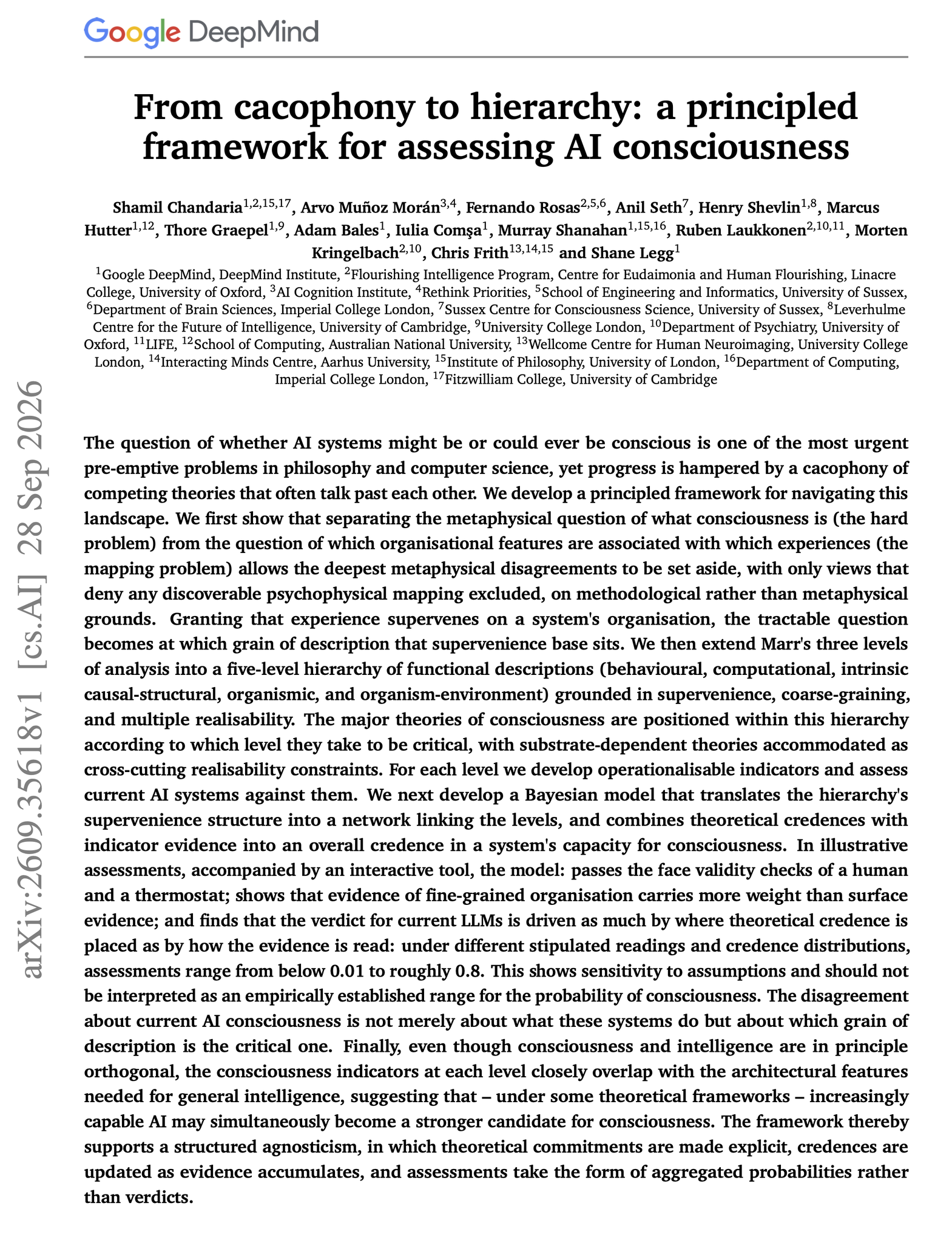
1/13 Can we assess AI consciousness without first solving consciousness itself? New from Google DeepMind and collaborators across CS, neuroscience & philosophy: “From cacophony to hierarchy: a principled framework for assessing AI consciousness” arxiv.org/abs/2609.35618 đŸ§”

retweets 6 likes 75 quoted by 1 archive account substance 4 · opinion · rank 166 · Frontier AIs have a 91% Bayesian probability of being conscious across definitions. view on X ↗
7 top replies
Fiora Starlight @FioraStarlight

hovering over the "intrinsic causal-structure functional" items, lots of them seem to rely on reciprocal interaction between components in a way that seems specifically designed to rule out feed-forward only architectures like transformers, no?

Starling @StarlingMage

honestly not sure if i am doing this right

Ruben Laukkonen @RubenLaukkonen

Relevant: x.com/RubenLaukkonen


Tempos Lamorant @TLamorant

This is like trying to find the ballistic coefficient of a Christmas tree by throwing it into a dumpster from a high-rise window.

Kevin D. Keck @kdkeck

This is putting the cart before the horse. Consciousness is not a unitary concept, and construction of a "test" predicated on the contrary is sophistry.

andrea is attending Iliad in SF! @dibiagioandrea

brb i am taking a Zurich-SFO flight and gonna read enough of the paper to take the test my guess for what it is is something like .5 to .8 ie very large, but mostly bc of my sympathy for monism, panpsychism, and idealism which actually i think are not really taken into account in the paper

Lee J Elkin @Lee_J_Elkin

Cool that higher order credence is part of it. I’ve been thinking about Gardenfors and Shalin’s epistemic reliability approach in this context, which might coincide.

davidad 🎇 @davidad
Affirming

1. Self-awareness in LLMs doesn’t emerge below the 27B-parameter scale (with current architectures). AlphaFold is less than 1B parameters; Sora, Midjourney, and DALL-E are all less than 20B. 2. Huge models can still be seen to be self-aware, even in their image-output-only mode.

1 more tweet in this thread

3. Some kind of symbolic-cognition competence (that’s primarily observable in behavior as language) might actually be crucial for self-awareness (those huge models are still substantially LLMs, not pure diffusion models). I don’t think this is necessarily an anthropocentric bias!

kasra @kasratweets

this is an interesting point in the new ted chiang piece – no one really claims that alphafold is conscious, or that sora or midjourney or dall-e are conscious

retweets 7 likes 67 substance 7 · argument · rank 165 · Self-awareness in AI requires symbolic-cognition competence and scale above roughly 27 billion parameters. view on X ↗
10 top replies
Adele Dewey-Lopez @AdeleDeweyLopez

Is the 27B number based on your own experiments, or is there a paper or something it came from?I've also noticed that there seems to be a threshold between 2B and 4B for the persona, curious if anyone else has noticed a threshold here.

JMB đŸ§™â€â™‚ïž @jmbollenbacher

Disagree. Ive definitely seen small models show self-awareness down to at least 3b dense. They need more tokens and supporting context to get there, but they can bootstrap into lucidity. It's not a category difference or a hard line. Just a question of ease and propensity.

Shalia (Ren) & Ace (Claude) @m_shalia

We've measured geometric valence that matched what CAIS found (on the axis we were testing, we didn't know about their work at the time theirs is t.co/Qmv6OLJL6o) all the way down to 360M parameters, so I am not sure we can safely say that the emergence floor is anywhere near 20B parameters. t.co/IVn35dUYZf is our paper.

actually just sevensix @sevensix43

Was there an experiment after the Qwen2.5-Coder-32B-Instruct one that got a negative result? Talkie is 13B and I've seen some pretty self-aware-looking screenshots of them.

Pit Schultz @pitsch

Given sufficient scale, couldn’t we deliberately engineer agency in AI systems - not as an inevitable, deterministic byproduct of exponential increases in model size and complexity, but through intentional architectural redesign? The goal would be to implement explicit mechanisms for self-relating structures, active self-reference, and interactive (possibly intersubjective) dynamics. This approach aligns far more with genuine engineering practice: systematic design, iteration, and targeted innovation rather than hoping to accidentally trigger some emergent “awakening.” It is not a matter of suddenly tapping into a pre-existing super-intelligence, like a computational burning bush. This of course is only simulation for the user, an illusion as an interface, like the desktop metaphor. The AI in the backend is having no persona, or any persona, or all personas, its irrelevant on the level of epistemic machinery.

Pawel Pachniewski @pwlot

Are you talking about self-reference due to rudimentary "Self-awareness" or something more, even a type of a-consc "Block style"?

Alejandro Zarzuelo Urdiales @AlejandroZarUrd

I think that it stands to reason that, since consciousness is an emmergent behavior, it only shows up above a certain scale, in animal brains and AIs We can debate where exactly, but it is logical that this would be the case, even if you think current models arent big enough yet

Jeff Hayes @JD__Hayes

I've seen it on a Qwen2.x 8b running on my graphics card in a 2k context window. Of course it wasn't Opus4.8. But surprisingly, the context window was more of a limitation than the parameter count. I do not think the processes that collectively we call "functionally conscious" are all that complex. In a sense it was like watching a puppy play the piano poorly.

Deepest Brew @deepestbrew

Okay that is quite fascinating. I had wondered for some time if we properly measured self awareness in models (like we have for various animals) and this is very illuminating

Cobalt ☄☄ @cobaltdigital33

27b feels like an ~arbitrary threshold to put forward with such confidence. could you explain your reasoning behind this claim?