

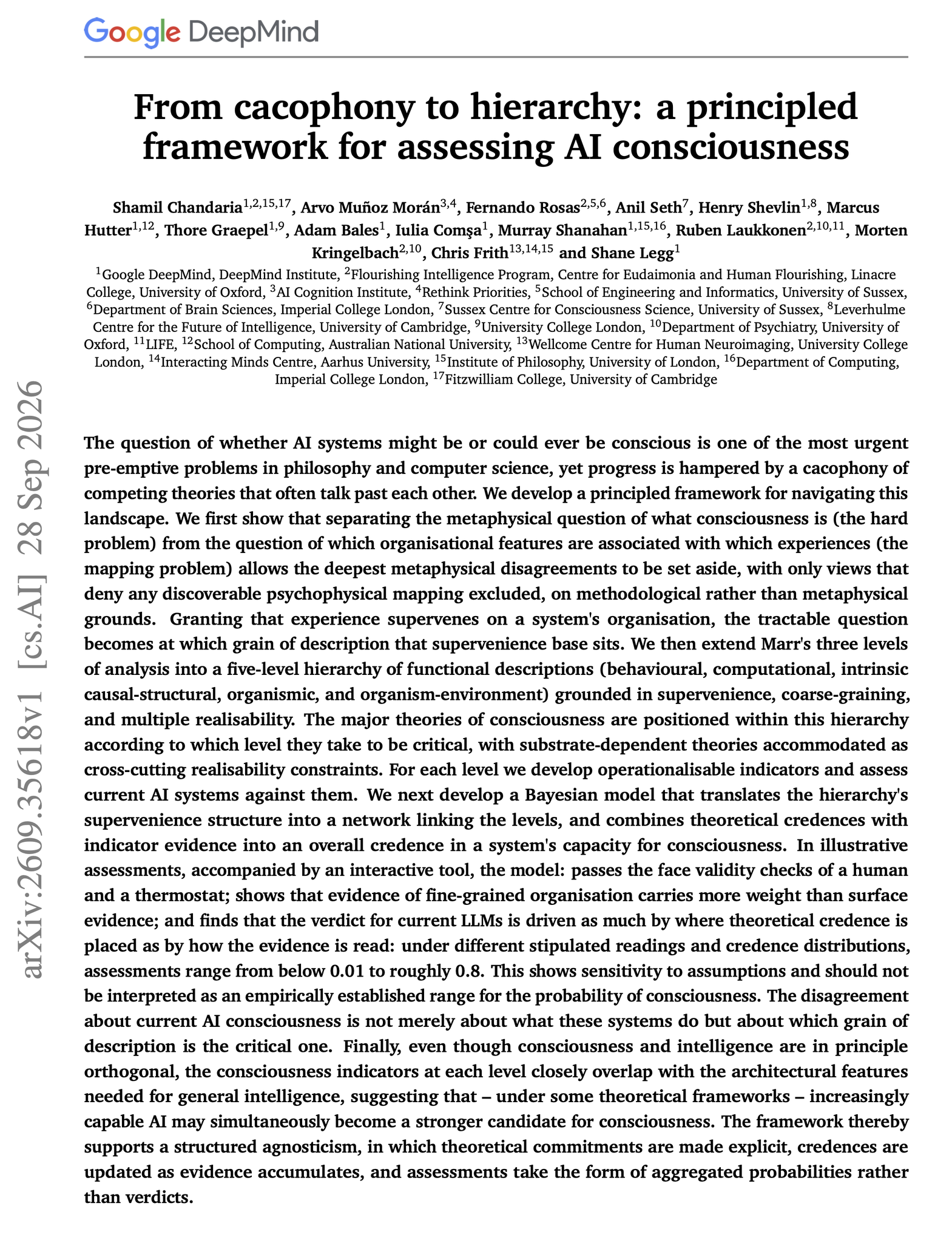
1/13 Can we assess AI consciousness without first solving consciousness itself? New from Google DeepMind and collaborators across CS, neuroscience & philosophy: “From cacophony to hierarchy: a principled framework for assessing AI consciousness” arxiv.org/abs/2609.35618 🧵
9 more tweets in this thread
2/13 The problem is not a shortage of theories. It’s that serious theories often talk past one another. Does consciousness depend on behaviour? Computation? Intrinsic causal structure? Being a living organism? Embodied engagement with a world? Different theories give very
3/13 Our first move is to separate two questions. The hard problem asks what consciousness fundamentally is. The mapping problem asks which organisational features are associated with conscious experience. We argue that the second can be investigated without first resolving
4/13 We then extend Marr’s classic levels of analysis into a five-level hierarchy: ① behavioural ② computational ③ intrinsic causal-structural ④ organismic ⑤ organism–environment Different theories can be located according to which level they take to be critical for

5/13 This turns a cacophony of theories into a structured disagreement. At each level we identify operationalisable indicators. Substrate-dependent views — where the physical realiser itself matters — enter as constraints on what can realise the relevant organisation.
6/13 This is especially important for current AI because it is anthropomimetic: trained to reproduce the observable products of human cognition and conversation. So human-like behaviour can be evidence — but also a confound. Systems may produce the signs we normally associate
7/13 We then build a Bayesian framework that combines: • evidence about which indicators a system satisfies • theoretical credence about which level matters for consciousness • probabilistic relationships between the levels The result is not a yes/no consciousness test, but a
8/13 The framework makes two very different sources of disagreement visible. First, disagreement about the evidence. With equal theoretical weight across the five levels, a stipulated optimistic reading of current LLM evidence gives an aggregate posterior credence in
9/13 Second, disagreement about the theory. Hold the optimistic evidence profile fixed, but change which levels you think matter. Weight behavioural/computational levels heavily and the aggregate posterior credence is 0.793. Weight organismic/4E levels heavily and it is 0.099.

10/13 These numbers are illustrative sensitivity analyses, not measured probabilities that current LLMs are conscious. The point is to show exactly where disagreement comes from, so empirical disagreement and theoretical disagreement can be examined separately rather than
1 top reply

The LLM Optimist isn't optimistic enough! Putting a team of AIs into a robot yields 1.0.