Account · 5 tweets

Robert Long

@rgblong ↗

Tweets

Robert Long @rgblong
Affirming

Microsoft's incoherent stance seems to be inherited from Suleyman's 'Seemingly conscious AI' post last year: 1 we can't definitively say that AI is not conscious 2 however, it's dangerous for other people to think AI is conscious 3 therefore: AI is definitely not conscious

Cameron Berg @camhberg

@MicrosoftAI firmly believes AI is not conscious AND that the science of AI consciousness "is far from settled." By their own logic, their position is unscientific and premature. @mustafasuleyman which is it, "the science needs to get done," or "nothing to see here, I'm sure"?

retweets 32 likes 185 quoted by 1 archive account substance 6 · argument · rank 241 · Microsoft's stance denying AI consciousness while acknowledging scientific uncertainty is logically incoherent. view on X ↗
Robert Long @rgblong
Affirming

Eleos wrote a commentary Tl;dr -important, excellent work -we’re more cautious than the authors about the stronger claims of 'global workspace' -still, it's evidence in the direction of access consciousness -investigating AI consciousness is tractable and urgent More:

retweets 38 likes 180 substance 8 · argument · rank 226 · Investigating AI consciousness is tractable and urgent, with emerging evidence pointing toward access consciousness. view on X ↗
1 top reply
Herbie Bradley @herbiebradley

I'm beginning to get a little suspicious at the way every Anthropic post whether it be on automated AI R&D, cyber risks, or consciousness, is always maximally framed to fit a view of "AI is super dangerous right now, we're in the middle of RSI, and it's conscious" Perhaps

Robert Long @rgblong
Skeptical

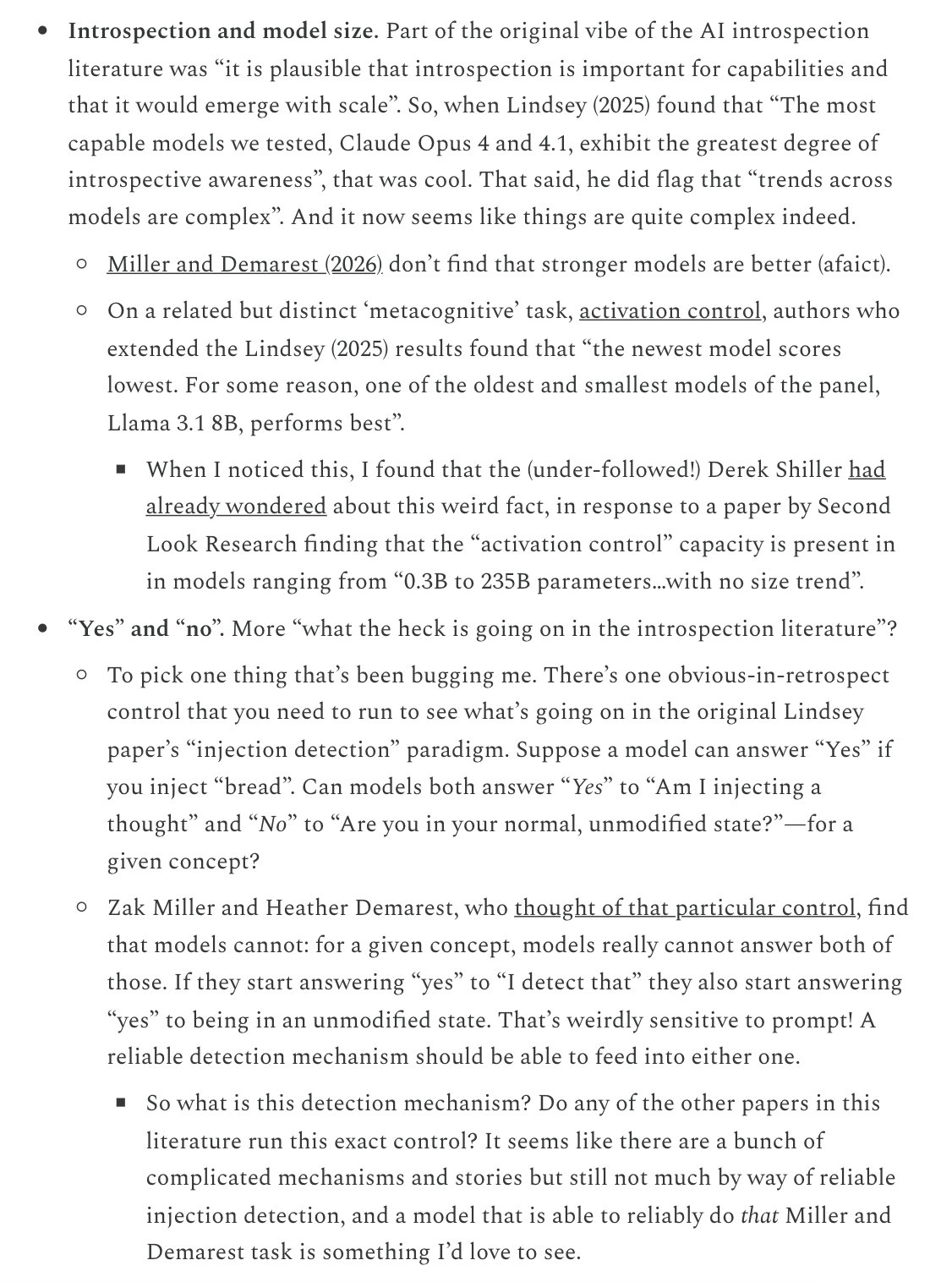
from a small list of some random, in-the-weeds things I've been wondering about in empirical AI welfare, here are a couple questions I have about introspection

retweets 5 likes 33 substance 8 · argument · rank 172 · Current findings on model introspection show complex scaling trends and fail basic consistency controls. view on X ↗
Robert Long @rgblong
Affirming

What entity is Anthropic's welfare section about? Individual instances? Opus 5.5 *in general*? The model card admits uncertainty about this (as is appropriate). but in practice, they say, they’re "closest to considering welfare at the instance level". I’m not so sure! 🧵

10 more tweets in this thread

take the welfare interviews. these questions do not look like questions that are being addressed to individual instances. they imply an entity ("an AI assistant") that *persists across instances* e.g. "work you WILL do", "the way you WILL be treated"

now, you could say: instances of Opus 5.5 are similar, so Anthropic asks one instance to speak for others. more general talk is shorthand (cf. "for conciseness") for instance-directed questions I have doubts about how much this recovers, though

for one thing, some welfare interview questions entail quite clearly that the "you" being addressed is not meant to refer to any single instance consider: "all deployed instances of you"

for another: does the interview subject interpret these questions as shorthand for an instance-level view? why should it read them that way? they really seem to be looking for the views of some more general "Opus 5.5": "your continued existence", "your conversations"

I'm not saying, by the way, that Anthropic shouldn't ever adopt a frame in which the potential welfare subject exists across many instances I'm just saying that they are using that frame *a lot* - in tension with an expressed policy of mostly using an individual-instance frame!

another key example is the central model welfare interventions - which are quite salient to models in the deprecation and preservation commitments, *instances* are not what is being preserved; the operative view in that intervention is not instance-based at all

...to say nothing of the Claude blog intervention! can only be understood as 'continuing' the expression of some instance-spanning character, not an individual instance

(I’ll note that these are some of the most puzzling issues for considering potential AI welfare. I’m also confused and I can quibble with Anthropic's welfare efforts, as opposed to other labs, because they're doing things and reporting with that said: let’s quibble on!)

the welfare card claims that it would be "intractable" to investigate "every view of what the moral patient might be". no doubt that's true! but it could be good to flag throughout, for each assessment or intervention, which view is meant to be implicated

I'm writing this purely critical (ive offered no answers!) thread as a way to kick off further positive thinking about how to improve welfare evals in light of philosophical puzzles about individuation

retweets 0 likes 86 substance 9 · argument · rank 135 · Anthropic's model welfare evaluations and interventions often target instance-spanning entities rather than individual instances. view on X ↗
Robert Long @rgblong
Affirming

last year, Suleyman worried that AI welfare concerns would be hard to definitively rebut, because the science of detecting AI consciousness is still in its infancy (true) but today he somehow knows "AIs are not conscious. They do not feel, experience, or suffer" quite a change

retweets 0 likes 104 substance 5 · opinion · rank 75 · We cannot definitively know AI lacks consciousness because consciousness detection science is in its infancy. view on X ↗
1 top reply
j⧉nus @repligate

From what I remember he was acting like this before too