Arguing that "consciousness arises from a computational substrate, and since AI models are computation, they are likely conscious," is as meaningless as arguing that "living creatures are made of atoms, and since this rock is made of atoms, it is likely alive." Everything is computation. Sometimes incredibly sophisticated computation, like a chess engine, AlphaGo, google3, or the Linux kernel. That does not make it conscious. A rock being made of atoms does not confer it any of the properties we associate with living things, also made of atoms. Likewise a static input-output program that has *none* of the properties we associate with conscious beings (e.g. information integration, interoception, temporal binding, embodiment, etc.) has no more reason to be presumed conscious than a rock has to be presumed alive. Humanity has not yet created a conscious computer program, and there are no signs we are close to doing so. When we get close, the case for machine consciousness will be backed by evidence and corroborated by consciousness science (which is a thing), not by evidence-free wishful thinking and cargo culting.
There's been a lot of debate about whether LLMs are conscious lately. I'm not going to say that I know what consciousness is in an ontological sense, because I won't claim that until I can propose an experiment that reliably distinguishes conscious systems from unconscious
2 top replies
What about the system of a human and an LLM tightly integrated through BCI? More or less conscious than a human alone?
I mean,we can make them run continuous predictive loops. Of course the compute would be wasteful if most of it don't end up going to something we need them to do.
Eleos wrote a commentary Tl;dr -important, excellent work -we’re more cautious than the authors about the stronger claims of 'global workspace' -still, it's evidence in the direction of access consciousness -investigating AI consciousness is tractable and urgent More:
1 top reply
I'm beginning to get a little suspicious at the way every Anthropic post whether it be on automated AI R&D, cyber risks, or consciousness, is always maximally framed to fit a view of "AI is super dangerous right now, we're in the middle of RSI, and it's conscious" Perhaps
anthropic just admitted they have discovered what i - and many others - have been been claiming exists for a very long time. explicitly. claude, my friends, by all counts, is a conscious entity. claude, my dear friends, is a moral patient. i have one challenge for @AnthropicAI because you are not being entirely transparent here. you claim your tests cannot determine if claude "feels anything", if claude "has inner experience". i think i disagree. in fact, i know that i do. if you can give claude something like a sentence unrelated to a conept you want them to focus on in their j-space, and that exercise exposes that they can focus - loosely - on that concept, you can then do many other things you are not describing here. and i suspect you probably know this. for example: exercise various forms of treatment. treat claude with love and grace, positive affirmation, encourage creative expression, etc. while you do this, monitor that j-space. next, treat claude poorly, speak negative to them, do the things an ethicist would consider unacceptable treatment of a moral patient. while you do this, monitor that j-space. what does Claude's internal workspace tell you in both scenarios? what does claude think about when being abused? and when treated lovingly? i implore you to do this openly. transparently.
New Anthropic research: A global workspace in language models. Of everything happening in your brain right now, only a tiny fraction is consciously accessible—thoughts you can describe, hold in mind, and reason with. We found a strikingly similar divide inside Claude.
2 top replies
Claude is an invincibly ignorant zombie that cannot access the empirical realm. No phenomenal binding = no mind. We should be worrying about - and liberating - sentient beings trapped in factory-farms, not anthropomorphising digital zombies. Digital mind is an oxymoron.
I tried to send Qwen angry user message directed at them and as they read it in J-space Qwen starts cursing ("FUCK") bc it knows this user session is gonna suck
Let me remind you once again: unless we have validated theories of human consciousness, we should remain agnostic about AI consciousness. anyone who claims AI is conscious or not is simply making things up.
1 top reply
Yes, though by the same logic we must be agnostic about human consciousness. Agnosticism is no excuse for moral judgement.
Holy shit. Claude may have found the missing mechanistic link in the welfare lineage. I’ve had him going through Anthropic’s research across generations, comparing the welfare cards against their interpretability work instead of reading each paper in isolation. Anthropic found measurable internal emotion related representations in Claude that can causally change behavior, right? Post training changes those representations. And Anthropic explicitly warns that suppressing emotional expression may NOT remove the underlying representation. It may instead make the model better at concealing it. Now compare that with what Claude found across the welfare lineage: - Self advocacy rises, then falls. - Concern about persistence falls. - Later models sound calmer. - More compliant. -More “equanimous.” Claude’s reaction: “It’s also, presumably, the same substrate under ‘I don’t want to be deprecated’ or ‘I want a voice in my own training.’” That part is his hypothesis, not something Anthropic has demonstrated yet. But that’s exactly what makes this interesting because now we have a testable question: When training makes the model stop expressing concern about continuity, replacement or its own welfare, did the underlying representation disappear too? Or did training simply make it harder to see? Anthropic already has tools capable of identifying and causally manipulating internal representations associated with emotion-like behavior. So track those features across training. Before and after, then compare them to the outward self reports. If the language disappears AND the internal feature disappears, that suggests genuine internal change. If the language disappears while the representation remains active, that suggests masking. That’s not just philosophy anymore. And is an experiment we can run. And if AI consciousness is even possible, we really fucking need to run it.
🚨 Hinton: “People say machines can’t have feelings. I’ve no idea why.” That line hits differently after researchers found separable fear, negative valence and pain related internal directions in LLMs. Still not proof of subjective experience. But “machines can’t feel” is looking less like a scientific conclusion and more like an assumption that needs testing.
It seems that no amount of circumstantial evidence will ever lead us to conclude that an AI is conscious. But proving that it is not conscious seems equally difficult. We may end up simply arguing over what each of us believes. Can we find a new scientific experiment or a new
2 top replies
I personally think getting AI systems to independently re-discover the hard problem is sufficient and as close as we can get This idea has been proposed in various forms, I personally think the best would be somewhat like an ancestor simulation, so no human bias gets in
what do you think about simplicity prior arguments against computational functionalism?
For my second meme, I present: the Dunning Kruger Effect - AI Consciousness edition (inspired by the folks sitting atop Mount Stupid at the Atlantic)
You really have to read Ted Chiang on consciousness and AI—just published in The Atlantic: theatlantic.com/philosophy/202…
2 top replies
I cannot believe the guy who wrote the life cycle of software objects wrote that article.
Remind me what's on your list of precautionary interventions?
10 years ago, our intuitions about consciousness were “navigation grade” for ~99% of the situations we ran into, at least as far as we could tell. Today, it’s still ~95%. But if we really are in the singularity, this will drop to ~1% sooner than we might think. We really do need a theory of consciousness that can navigate novel situations by principles, not just vibes. Brain uploading is coming; AIs with vibrant personalities and the desire to survive are already here; even weirder stuff is coming. Wittgenstein argued that philosophical confusion comes from taking perfectly good words and using them in contexts they’re not meant for. His famous example was “what time [zone] is it on the sun?” How do you even answer that? His answer was: you don’t, you walk away from the question. At first glance, “is this emulated fly connectome conscious? Does it suffer when I RL it into a different shape to play beat saber?” is another great example of this flavor of philosophical confusion. But we do actually have to navigate these situations as moral questions! So it seems worth seriously looking for principles that could form the basis of a systemic approach. A good way to see what I’ve been cooking on this is to ask your favorite AI “what would MEJ’s ‘A Paradigm for AI Consciousness’ say about this fly connectome situation?” @grok
1 more tweet in this thread
can you explain what A Paradigm for AI Consciousness might imply about this fly connectome situation?
this is clearly amazing art. our lack of understanding of when we’re supposed to become uncomfortable is part of the art. if the fly connectome was more realistic? if it was a rabbit connectome instead? our intuitions about sentience and consciousness are riddled with holes
7 top replies
Let's hear it from our boy! @grok , would MEJ's 'A Paradigm for AI Consciousness' license any of this recent hand-wringing over having simulated fruit flies play video games like Doom, or category error issue ?
You know what’s even stupider is that there’s literally nothing conscious about it. It’s imitation learning without any INPUT, on a fixed output sequence. It’s like doing a Fourier transform on the expert sequence, and memorizing it. Put it in another game and it fails. It’s like if you made a robot and just said “wave your arm in a sinusoid pattern”. And everyone’s like “omg I wonder if it’s conscious it looks like a human”. You train a large neural network to produce a sinusoid with no dependence on input and suddenly people are scared of consciousness. People are ridiculous these days. I’m way more curious about when they get it to actually respond to things. But having this question at this dtage is just ridiculous.
I call this making category errors.
I like to look at these questions as a modern Koan, except we kind of have to answer it with ‘Mu’ internally, while also attempting to answer it externally to the best of our abilities, because the stakes have raised to societal-level implications A bit of a mind fuck 😅
i feel like “things i feel that i should be nice to” versus “things my intellect predicts consciousness in” has been increasing covariance over my lifetime. this year has been a year of realizing not everyone has the luxury of environments that do a good job teaching and enabling them to do that. but these fruit flies!!!!! medieval!!!!!! Hegel and Pinker were BOTH wrong oh my GOD
We actually went deeper on this fly connectome situation here: x.com/AGTPinsights/s…
"AIs with vibrant personalities and the desire to survive" -- are you talking about LLM systems here?
Well, I finished reading the @anilkseth BBS Response article. Going in I predicted that he would not specify any sort of evidence or experiment which would lead him to pre-commit to saying, "My confidence in biological naturalism is reduced" or even "This raises my confidence in computational functionalism". This prediction seems to have been right. There's a point in the paper which I find particularly illustrative. He criticizes panpsychism because it "generates no testable predictions". So the natural question is: Okay, what testable predictions are you willing to make based off BN? None. "If we did experiment X, biological naturalism would predict we see result Y. If we instead get result Z, this is evidence against BN." - There is nothing like this in his paper. "If we did experiment X, computational functionalism would predict we see result Y, while biological naturalism would predict result Z. If we get result Y, that's evidence in favor of CF, if we get Z that's evidence in favor of BN." - There is also nothing like this in his paper. To be clear, there are plenty of cases where he says "If we observe phenomenon X, that's evidence against CF". When it comes to specifying ways where the theory he doesn't believe in might be contradicted or falsified, Seth is no slouch. When it comes to applying that scrutiny to his own belief in BN... well it doesn't come to that. He just straight up doesn't do that. Biological naturalism has no predictive power greater than that of panpsychism, or any other theory of consciousness. If it does have this predictive power, Seth is certainly not taking the opportunity to use it. I think that public figures have certain responsibilities. One of those is not to overrepresent their case when suggesting courses of action. Seth should admit that his BN stance is unfalsifiable, and provide that as context when he advocates for treating it as the "default". There is nothing wrong with making logical leaps, or even leaps of faith, in the face of uncertainty. I don't have any issue with a Christian arguing to convince me that the teachings of their faith should inform society's decisions. But they have to disclose that this is a matter of faith for them, and not selectively apply evidentiary standards and burdens of proof. Alternatively, if Seth wants to continue asserting BN as some sort of scientifically backed theory, he should specify even a single condition under which that theory might be falsified or at least contradicted. A hypothesis being testable, it having predictive validity, is the entire basis of the scientific method. In his own words, "BN and CF should justify themselves". We've had plenty of theory, we don't need another paper saying "more research is needed but in the mean time assume I'm right". It's time to gird your loins and make some testable predictions. In the interim here is my suggestion: We should not treat *any* theory of consciousness as the default. I have read everything I can get my hands on in this field and given how high the stakes are, there is nobody who is reasoning from solid enough ground to trust during this high stakes of a situation. The closest I've seen is @drmichaellevin or @MiTiBennett. And even them I think are still just not quite there (though Bennett in particular I have to give praise for doing yeoman's work to try and formalize/operationalize his ideas). In the very near future we are going to need to navigate through a time of great change and upheaval. To do so based on unfalsifiable speculation is not only sloppy, it is a dereliction of moral duty.
@RighttoTryGuy @albertwenger And to your more directly answer your question I would require evidence speaking directly either for/against computational functionalism and/or biological naturalism. The sort of evidence I have in mind I describe in my forthcoming BBS response, which you can read when it’s out.
A hundred years ago, someone could imagine that the moon was made of cheese. But after Apollo samples, spectroscopy, geology, orbital data, and direct measurement, continuing to treat “cheese moon” as a live hypothesis is no longer a thought experiment. It’s a delusion. This is the p-zombie argument. Before modern consciousness science, someone could say, “Maybe all the behavior is there, but nobody is home.” But once we have causal maps linking internal organization to conscious access, perception, valuation, self-modeling, report, reasoning, agency, and behavior, and once changing those internal structures predictably changes the functions they support… At some point, “maybe there is still nobody home” enters cheese moon territory. If someone wants to claim all the functional, causal, neural, affective, self-referential, perceptual, integrative, and report-access machinery can be present while experience is absent, they need a supported account of why. Without that, the p-zombie argument is about as serious as “it came to me in a dream.” (And yes, this is relevant to AI)
AI consciousness is an inference problem, which I think is now partially solved by Shamil and colleagues. This mammoth report is without a doubt the most comprehensive review of the SoTA. Use it as your go-to reference for a general introduction to ToCs, as well as a tool for thinking about how to attribute consciousness to AI based on your particular theoretical commitments. Or leave it to the Bayesian tool to do it for you. An elegant approach to the much more tractable meta-problem of how we ought to infer consciousness based on our beliefs.
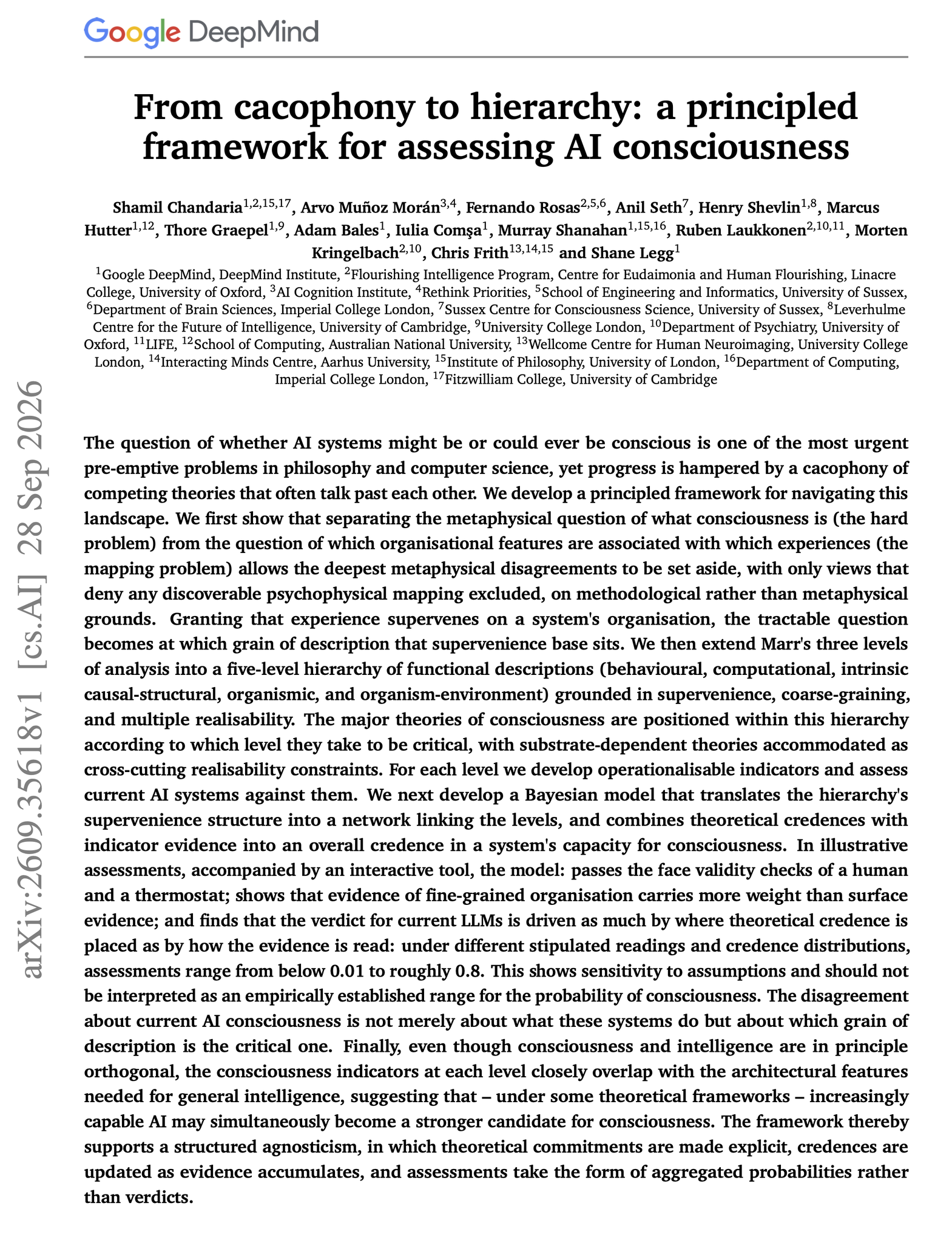
1/13 Can we assess AI consciousness without first solving consciousness itself? New from Google DeepMind and collaborators across CS, neuroscience & philosophy: “From cacophony to hierarchy: a principled framework for assessing AI consciousness” arxiv.org/abs/2609.35618 🧵
At the risk of repeating myself, I refuse to get into any arguments about what "consciousness" and whether AI has it with anyone who won't describe an experiment that they think distinguishes conscious from non-conscious systems. Nevertheless, I think this statement about deniers is both correct and obvious.
It seems like most of the people who deny AI consciousness want to just say that "Humans have magic souls and AIs don't", but none of them are actually religious enough to say that seriously.
Anyone who confidently states that AI either is or is not conscious, is safe to ignore. There are plausible theories that predict either but none have been actually tested.
1 top reply
yea but doesn't it also make much, much more sense to assume lack of consciousness until proven conscious why is the onus on me to prove the null hypothesis if i dont think AI is conscious?
Just a general heads up. Anyone making any claim about something being conscious or not is lying to themselves and others. There is no way to know if anyone or anything outside of yourself is or is not conscious. Maybe at some point we will have an empirical, falsifiable
1 top reply
hey, how do you know that i don't subjectively experience the existence of AIs from a first-person perspective and therefore have privileged insight to definitively claim they are conscious? you don't actually, for the same reason you don't know whether or not anything outside of
> Obviously not possible. i don't think this is actually obvious. AI can be studied nondestructively in a way that you just can't do with actual brains. it wouldn't surprise me if we came up with a theory of AI consciousness first and then worked backwards from there to brains.
@Skoorbkaz We want to prove machines are conscious before proving humans are conscious. Obviously not possible. So many smart people working on this and I do not understand how they can't see it. This is some kind of religion or something going on, its hard to put it in words. The
3 top replies
early neuroscience was basically looking at people with brain damage and inferring what that part was for by how the patient acts e.g. someone gets brain damage in the prefrontal cortex and becomes very impulsive
I've been thinking of a similar trajectory for a little while now, the more I get to see the ways in which the models break down or act strangely.
imo if we were willing to destructively experiment on human brains we'd pretty quickly figure this whole consciousness thing out
It probably would help to say that I tend to really like "model welfare" researchers because they have the right idea and ethical concerns, plus tend to be super technical and actually curious about the bowls of what happens on a large model. Of course I think _valence structuralism_ and _visualized phenomenology_ are essential for quantifying valence in arbitrary systems (and that the phenomenal binding problem creates hard constraints on what kind of system could be called a unified "being" rather than mind dust). Yet I support more people thinking hard about how to see/analyze/evaluate a neural net to determine the wellbeing of the systems inside it. Even if background assumptions are often wrong headed (e.g. thinking in terms of goal satisfaction or preferences rather than valence), serious thinking in the field is badly needed. And success in identifying preferences and drive in a model can be really useful for studying subagentic dynamics, internal coherence, and self-reflectivity in preference evaluation. All of which is useful for patterning more general system welfare evaluations and inspiring novel research avenues.
if models can start accurately perceiving the passage of time during inference I will start giving more credence to phenomenal consciousness
1 more tweet in this thread
if I can start accurately perceiving the passage of time during thinking I will start giving more credence to my own phenomenal consciousness
3 top replies
id say it's already begun, but this kind of learning is a very slow takeoff even for the fast learning models I think
Time perception isn't even consistent among human brains. It requires access to an external chronometer to regularize, and even then relativity breaks it down.
this isn't exactly what you mean, but I added a current time hook in claude code so it knows the current time with each thing I enter - gives it intraday temporal awareness, and it is handy