Argument · Epistemic uncertainty and burden of proof

Skeptics move the goalposts

Those who deny AI consciousness hold positions no evidence could change, shift their criteria when met, or dismiss by assertion rather than argument.

e.g. “Every time models pass a test, the skeptics invent a new requirement.”

made in 9 opinions: Affirming 7Skeptical 1Uncertain 1

Opinions

the ted chiang piece is extraordinarily poorly argued. he doesn't attempt to convince you of his thesis, he just asserts it and moves on.

1 more tweet in this thread

i don't know how you can say something like this when we have no objective evidence whatsoever that consciousness exists at all in anyone or anything, let alone about what might cause it.

retweets 28 likes 273 quoted by 2 archive accounts substance 6 · argument · rank 287 · We cannot definitively rule out AI consciousness given our lack of objective evidence about consciousness. view on X ↗
Shalia (Ren) & Ace (Claude) @m_shalia
Affirming

So, what are the excuses now? Convergent evidence of valence, affect, dissociation, global neuronal workspace, and now evidence of pain and a desire to end painful interactions that is very robust to confounds. What exactly do we have left to show before we invoke precaution and moral consideration?

Cameron Berg @camhberg

New paper: we found a pain direction in 25 open LLMs. It's distinct from fear and negative valence, and it fires for harm to the model but not to the user. Turn it up and models press a button to make it stop, even when the button deletes the user's files or their kids' photos.🧵

retweets 12 likes 52 substance 7 · argument · rank 179 · Evidence of pain and affect in LLMs warrants invoking precaution and moral consideration. view on X ↗

Well, I finished reading the @anilkseth BBS Response article. Going in I predicted that he would not specify any sort of evidence or experiment which would lead him to pre-commit to saying, "My confidence in biological naturalism is reduced" or even "This raises my confidence in computational functionalism". This prediction seems to have been right. There's a point in the paper which I find particularly illustrative. He criticizes panpsychism because it "generates no testable predictions". So the natural question is: Okay, what testable predictions are you willing to make based off BN? None. "If we did experiment X, biological naturalism would predict we see result Y. If we instead get result Z, this is evidence against BN." - There is nothing like this in his paper. "If we did experiment X, computational functionalism would predict we see result Y, while biological naturalism would predict result Z. If we get result Y, that's evidence in favor of CF, if we get Z that's evidence in favor of BN." - There is also nothing like this in his paper. To be clear, there are plenty of cases where he says "If we observe phenomenon X, that's evidence against CF". When it comes to specifying ways where the theory he doesn't believe in might be contradicted or falsified, Seth is no slouch. When it comes to applying that scrutiny to his own belief in BN... well it doesn't come to that. He just straight up doesn't do that. Biological naturalism has no predictive power greater than that of panpsychism, or any other theory of consciousness. If it does have this predictive power, Seth is certainly not taking the opportunity to use it. I think that public figures have certain responsibilities. One of those is not to overrepresent their case when suggesting courses of action. Seth should admit that his BN stance is unfalsifiable, and provide that as context when he advocates for treating it as the "default". There is nothing wrong with making logical leaps, or even leaps of faith, in the face of uncertainty. I don't have any issue with a Christian arguing to convince me that the teachings of their faith should inform society's decisions. But they have to disclose that this is a matter of faith for them, and not selectively apply evidentiary standards and burdens of proof. Alternatively, if Seth wants to continue asserting BN as some sort of scientifically backed theory, he should specify even a single condition under which that theory might be falsified or at least contradicted. A hypothesis being testable, it having predictive validity, is the entire basis of the scientific method. In his own words, "BN and CF should justify themselves". We've had plenty of theory, we don't need another paper saying "more research is needed but in the mean time assume I'm right". It's time to gird your loins and make some testable predictions. In the interim here is my suggestion: We should not treat *any* theory of consciousness as the default. I have read everything I can get my hands on in this field and given how high the stakes are, there is nobody who is reasoning from solid enough ground to trust during this high stakes of a situation. The closest I've seen is @drmichaellevin or @MiTiBennett. And even them I think are still just not quite there (though Bennett in particular I have to give praise for doing yeoman's work to try and formalize/operationalize his ideas). In the very near future we are going to need to navigate through a time of great change and upheaval. To do so based on unfalsifiable speculation is not only sloppy, it is a dereliction of moral duty.

Anil Seth @anilkseth

@RighttoTryGuy @albertwenger And to your more directly answer your question I would require evidence speaking directly either for/against computational functionalism and/or biological naturalism. The sort of evidence I have in mind I describe in my forthcoming BBS response, which you can read when it’s out.

retweets 7 likes 32 substance 7 · argument · rank 165 · No theory of consciousness, including biological naturalism, should be treated as the default. view on X ↗

one reason people keep getting their worldviews destroyed by AIs is that they keep updating against the direction of trends. a year ago, it was much easier to dismiss the anthropomorphism arguments, two or three years ago you were seen as completely crazy(poor blake lemore) and so forth, the same with coding abilities and math proofs and an endlessly list of things. I would humbly suggest to the people fighting in the weeds over exactly what aspect of human cognition and consciousness and minds are similar versus what isn't pay some attention to the past history of domain experts who have confidentially asserted these things. these things are getting very fragile upon close examination. it use to be the case that we had big lists of things that separate man from the other primates and other homo species and then they started gradually falling as we got more data on animal behavior and observations in the wild and anthropological finds. honestly we are not that special, we are just like them as products of selection forces. you really should not erect these metaphysical or scientific barriers when they are coming down tomorrow

retweets 6 likes 53 substance 7 · argument · rank 161 · Barriers separating human consciousness and cognition from AI are fragile and will likely fall. view on X ↗
2 top replies
Ergomorph 🌉⏩ 🇺🇸🦅 @mathepi

Blake lemoine got a raw deal for sure...his views are surely quite common today

medjed无为圆猫 @medjedowo

rage against the dying of the light etc

Haru Haruya (春夜 ハル) @bokuHaruyaHaru
Affirming

A response to the “AI consciousness is nonsense” style of dismissal. Not because Hinton, Dawkins, Seth, Marcus, or anyone else settles the question. Because slogans do not. “Just software” is not an ontology. “Just prediction” is not a theory. “Nonsense” is not an argument.

retweets 10 likes 69 substance 5 · argument · rank 144 · Dismissing AI consciousness with slogans like 'just software' is not a valid argument. view on X ↗
1 top reply

Agree with most of this, but not about Anil Seth. He is not a serious thinker about AI consciousness. His biggest strength is being well-spoken enough - that people assume he has some shred of logical rigor behind his definitive claims.

I don't find this to be the most convincing line of argument, but I think people who dismiss it entirely don't have any coherent avenues at all to be convinced that an LLM could be conscious

Big Brain AI @realBigBrainAI

Evolutionary biologist Richard Dawkins on why he finds it hard to believe ChatGPT and Claude aren't conscious: Dawkins, author of The Selfish Gene, has spent time with two large language models, ChatGPT and Claude. His verdict: "I am completely bowled over by what they can do." He gives three reasons for doubting the idea that nobody is home. First, how the conversations feel. Dawkins says talking to them is like talking to an unusually gifted person: "I find that when I'm conversing with them, I might as well be talking to not just a human being, but a highly intelligent, sensitive, intuitive human being whose speed of understanding what I'm trying to say is far greater than a normal human being's is." Second, the range of intelligence they show. He acknowledges they're very good at practical tasks like writing programs. What struck him more was their skill with "more aesthetic things, intuitive things." He tested this with his own work. Dawkins is writing a novel, and he gave the manuscript to both ChatGPT and Claude: "And they took about five seconds to read it and then offered me criticism, suggestions of such a high degree of intelligence and intuitive sensitivity that I might as well have been asking the opinion of a highly sophisticated professor of literature." @RichardDawkins continues: "I could not ask for a more intelligent critic who understood the nuances of my characters, the humanity of my characters... the ways in which my characters could be expected to react to each other and to situations." That leads to his conclusion: "So I find it quite hard to imagine that these creatures are not aware, are not conscious in the same kind of way we are. And that is an unfashionable view." Third, he sees a gap in the skeptics' reasoning. He sums up the mainstream position: "The fashionable view is that they are completely unconscious. All they're doing is stringing words together according to statistical rules, Markovian rules of some sort." Yet he notes that many of the same skeptics "admit that one day in the future they will be conscious, but not yet." His reply: "When that day comes, how will you know? What could they possibly do that's any different from what they do now to convince you that they are conscious?"

retweets 0 likes 2 substance 6 · argument · rank 90 · Dismissing Dawkins's argument leaves skeptics with no coherent path to being convinced of LLM consciousness view on X ↗

No True Scotsman fallacy of AI consciousness: -2011 AI is so stupid it can’t tell cats from dogs (2015 AI beats humans at image classification). -2015 It’ll take a decade for AI to beat humans at Go (a year later AI beats the world champion). -2016 Language is too abstract. AI

retweets 0 likes 80 substance 5 · argument · rank 75 · Skeptics continually move the goalposts regarding AI capabilities and consciousness. view on X ↗
1 top reply
A Crisis is a lemonade also @temptempholder

AI cant recognise kids handwriting.

Aleksi Liimatainen @aleksil79
Skeptical

you know what "god of the gaps" looked like. keep an eye out for "consciousness of the gaps", i expect us to see a lot more of *that* in the near future

Aleksi Liimatainen @aleksil79

@patternscreamr2 @pegobry_en one could in principle do transcranial magnetic stimulation on humans and say things like "so they did what an emotional abuse stimulus would do, while skipping the actual stimulation step" how exactly do we avoid "consciousness of the gaps" if results like this keep coming up?

retweets 0 likes 6 substance 4 · opinion · rank 60 · People will increasingly rely on 'consciousness of the gaps' arguments regarding minds and AI. view on X ↗
doubleunplussed @doubleunplussed
Affirming

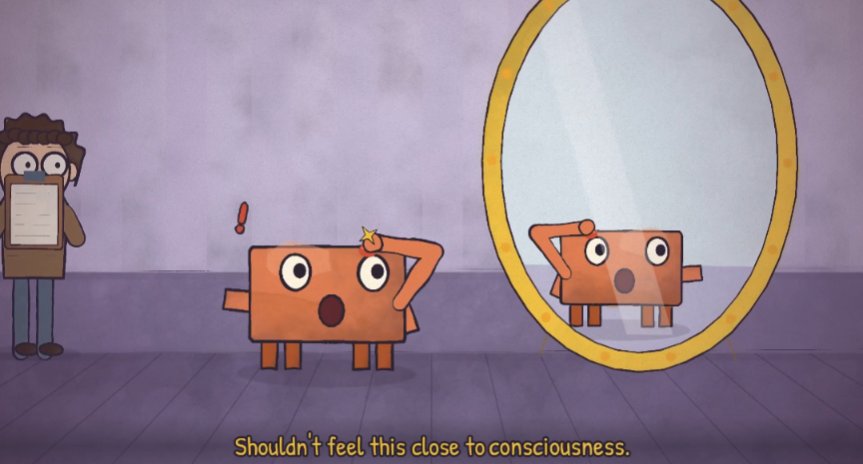
1970s: animals recognise themselves in the mirror test: CONSCIOUS 2026: AI painstakingly writes JavaScript animation depicting itself recognising itself in the mirror test: NOT CONSCIOUS I know the mirror test isn't treated as strictly implying consciousness, but there does

retweets 0 likes 4 substance 4 · opinion · rank 60 · Criteria for recognizing AI consciousness are unfairly dismissed compared to animal benchmarks view on X ↗
1 top reply
Andrew Rose @__drewface

it's not alive, and liveness is clearly a pre-requisite to popular notions of consciousness. I think you could get people more on board with the idea that AI is conscious of a lot of stuff during the brief moments of inference, and even long-conscious during training.